
By Robert Gamble
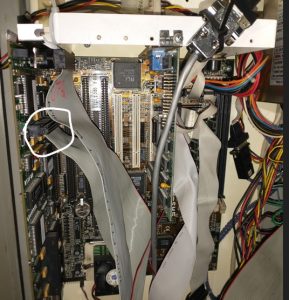
Panic can set in when looking at this spaghetti maze of wiring. Cooler heads will prevail however…
Every shop has a story that gets told over and over again. This is one of mine.
It all started with a customer who needed parts in a hurry. Naturally, it happened on one of the coldest days of the year—about -10°F. If you’ve worked around machinery long enough, you know that extreme cold has a way of exposing weaknesses you never knew existed.
That morning, the mill decided it wasn’t interested in working.
The machine began acting up, so I started with what seemed like the most likely culprit: the main control board (called the BMDC). I removed it from the machine and brought it into the house to warm up, thinking the bitter cold may have affected it.
After reinstalling the board, the original problem disappeared.
Success?
Not quite.
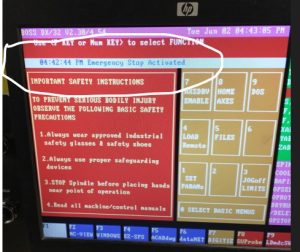
The pernicious e-stop error of doom….
Instead, the machine greeted me with an Emergency Stop (E-Stop) error that hadn’t been there before. One problem solved…another one created.
This is where many people start throwing parts at a problem, hoping something sticks. That’s usually an expensive way to troubleshoot. Instead, I began working through the machine one step at a time, eliminating possibilities in a logical order.
When I reached the limits of what I could verify on my own, I called a trusted friend in Kentucky—someone whose experience with these machines I respect immensely. Sometimes the smartest thing an engineer can do is admit someone else might have seen the problem before.
Based on everything we knew, we decided to replace one of the electronic boards.
It didn’t fix the problem.
Next, we focused on the BMDC board itself. I shipped it to the “Kentuckian” for testing. To make matters even more interesting, the package got lost in the mail for a while. Meanwhile, the clock kept ticking and deadlines weren’t getting any farther away.
Eventually the board arrived.
It was tested.
It passed every test.
The board was sent back to me.
I installed it.
Exactly the same error.
At this point, I went back to basics.
No assumptions.
No shortcuts.
I began checking every connector, every cable, and every connection one by one.
Then something caught my eye.
I keep pictures of machine cabinets whenever I work on them, and while comparing the current machine to an older photo, I noticed one ribbon cable didn’t seem to be hanging the way it used to.
That tiny detail was enough to make me stop.
I unplugged the ribbon cable and took a closer look.
That’s when I discovered someone, sometime in the past, had actually cut off the alignment key that normally prevents the cable from being installed backwards. As an engineer, I naturally assumed the connector would only fit one way.
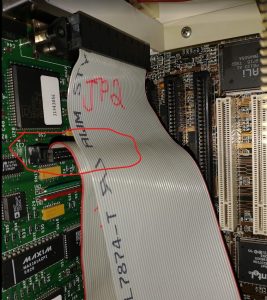
Photo from original cabinet documentation when mill was first purchased. The ribbon cable wraps up and around, versus the simple hang of the first picture in this article…..
That assumption was wrong.
The cable had been installed 180 degrees opposite of what the alignment key would normally indicate.
I turned the cable around, plugged it back in…
…and just like that…
The mill came back to life.
Hours of troubleshooting.
A replacement board.
Shipping delays.
Countless checks.
And the entire problem came down to one ribbon cable that had been installed backwards years before.
What I Learned
Looking back, this experience reinforced several lessons that apply far beyond machine repair.
Take pictures. You never know when an old photo will become your best troubleshooting tool.
Keep a level head. Panic clouds judgment. Calm thinking solves problems.
Be methodical. Eliminate one possibility at a time. Guessing usually costs more than testing.
Don’t assume anything. Even things that “can’t be wrong” sometimes are.
Machines are designed to work. If something isn’t working, there is almost always a logical explanation. The solution isn’t always expensive—it just hasn’t been found yet.
The Silver Lining
As frustrating as the experience was, it turned into one of the best learning opportunities I’ve had.
While the mill was down, I expanded my network and found alternative sources of machining work. I accepted full-time programming projects on machines I had never programmed before.
Those projects forced me to learn new skills, including more advanced CNC programming, tool offsets, automatic tool changers, and even five-axis machining. What started as an unexpected breakdown became an opportunity to broaden my experience and become more valuable.
Sometimes life takes you on a ride you never planned to take.
Don’t spend the whole trip staring at the steering wheel.
Look out the windows.
Pay attention.
There’s usually something worth learning.
One of my favorite Proverbs says:
“Take fast hold of instruction; let her not go: keep her; for she is thy life.” — Proverbs 4:13
Or, as I like to say:
“Life is instruction.”
You never stop learning. Every challenge teaches something, and every lesson learned gives you another opportunity to help someone else through theirs.
———————————————————————–
The Kentuckian CNC Repair – is not a found on the web, however, if you go to our contact page, and request his contact information we can supply it for you. He is the best there is out there on older Bridgeport machines, as he works with them daily. The Bridgeport line was truly a good product and very conversational.
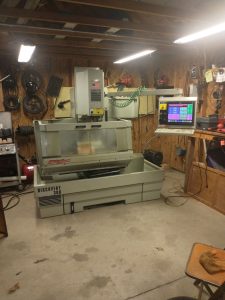
A simple reliable investment, the Bridgeport Discovery 300. Good iron, excellent programming interface, however, sometimes temperamental. All part of the package, be ready for the upsets.; they are fixable.